Experience the Allure of France: A Journey Through Time and Beauty
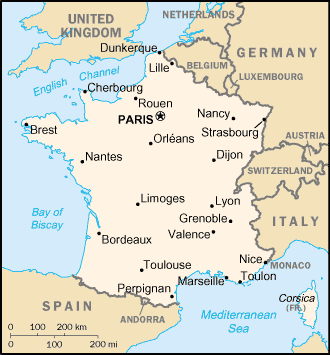
Step into the enchanting realm of France, a country that has captivated the hearts of travelers for centuries. With its roots reaching deep into the annals of history, France's narrative weaves through the eras of the Gauls, the might of the Roman Empire, the opulence of the French monarchy, and the revolutionary spirit that reshaped its destiny. This land of elegance and diversity invites you to explore its rich culture, iconic landmarks, and exquisite cuisine.
The Saga of France: A Legacy of Civilization
France's story is painted with the brushstrokes of time, from the prehistoric Lascaux caves to the grandeur of the Renaissance, and beyond to the modern-day Republic. It's a history filled with artists, warriors, and visionaries, all of whom have left indelible marks on the fabric of French society.
Paris: The Heartbeat of France
The City of Light beckons with its timeless charm. Paris, France's capital, is an anthology of artistic and architectural masterpieces, with the Eiffel Tower, Notre-Dame Cathedral, and the Louvre Museum as its crowning jewels.
The Riviera: Azure Shores and Glitzy Glamour
Delve into the chic allure of the French Riviera. Nice, Cannes, and Saint-Tropez are synonyms for sun-drenched beaches, cultural festivals, and the sparkling Mediterranean.
Provence: A Tapestry of Lavender Fields and Ancient Ruins
Provence enchants with its rolling vineyards, fragrant lavender fields, and Roman heritage, epitomized by the well-preserved Pont du Gard and the historic city of Avignon.
The Loire Valley: A Castle-Studded Dreamscape
Travel back in time in the Loire Valley, a region dotted with fairy-tale châteaux and verdant, vineyard-laced landscapes that inspired generations of royalty and artists alike.
From the windswept coasts of Normandy, rich with history from medieval times to World War II, to the gastronomic pleasures of Lyon and the snowy peaks of the French Alps, France offers a tapestry of experiences. Join us at travel.frogsfolly.com as we guide you through the cobbled streets, into the heart of French culture, and through the doorways of history. Embark on a French adventure that will leave you with memories as rich as a Bordeaux wine and as vivid as a Cézanne painting.


![<p><a href="https://www.flickr.com/people/meteorry/">Meteorry</a> posted a photo:</p>
<p><a href="https://www.flickr.com/photos/meteorry/55556132047/" title="Pont du Carrousel - Paris (France)"><img src="https://live.staticflickr.com/65535/55556132047_129f7897b4_m.jpg" width="240" height="160" alt="Pont du Carrousel - Paris (France)" /></a></p>
<p><b>Pont du Carrousel</b> 03/03/2026 17h45<br />
Musée du Louvre and Quai François Mitterrand seen from the Pont du Carrousel. <br />
<br />
<u>Pont du Carrousel</u><br />
Pont du Carrousel is a bridge in Paris, which spans the River Seine between the Quai des Tuileries and the Quai Voltaire.<br />
History begun in 1831 in the prolongation of the rue des Saints-Pères on the Left Bank, the original bridge was known under that name until its inauguration, in 1834, when king Louis-Philippe named it Pont du Carrousel, because it opened on the Right Bank river frontage of the Palais du Louvre near the Arc de Triomphe du Carrousel in front of the Tuileries.<br />
The bridge's architect, Antoine-Rémy Polonceau, succeeded in a design that was innovative in several aspects. For one thing, the new structure was an arch bridge, during a period when most bridge construction had turned to suspension bridges; the necessary towers and cables would have been considered unacceptable additions to the Parisian scenery. The structure combined the relatively new material of cast iron with timber. Its gradated cast-iron circular supports were quickly dubbed "napkin rings" (ronds de serviette). At each corner of the bridge were erected classic style stone allegorical sculptures by Louis Petitot, which remain in situ. They represent Industry, Abundance, The City of Paris and The Seine.<br />
In 1906, after seven decades of use, serious restoration was required; the former wooden elements were replaced with beaten iron. Nevertheless, the bridge was too narrow for twentieth-century traffic, and shifted alarmingly. In 1930, its height above the river was judged insufficient for river transportation, and it was decided to scrap it for an entirely new structure to be built a few tens of meters downstream from the former one, and with greater headroom on the river. The architects Malet and Lang attempted to respect the former aspect, which now had become familiar to Parisians. The new bridge of reinforced concrete still crosses the river in three arches reaching the right bank in front of the Louvre, in direct line with the Arc de Triomphe du Carrousel. For its lighting at night, the iron craftsman Raymond Subes conceived an ingenious telescoping system that raised the streetlights from a height of 13 meters in the daytime to 20 meters at nightfall when they were lit; however, the system is too fragile to be of any use and does not function.<br />
On 1 May 1995, the Moroccan immigrant Brahim Bouarram drowned after being thrown from the bridge into the river by members of a crowd gathered by the Front National. In 2003, in the name of all the citizens of Paris, the mayor of the city, Bertrand Delanoë, honored the memory of Bouarram and all the victims of racism with a commemorative plaque on the bridge.<br />
The nearest Métro station is Palais Royal - Musée du Louvre.<br />
Length 168 meters, width 33 meters <br />
[ <a href="https://en.wikipedia.org/wiki/Pont_du_Carrousel" rel="noreferrer nofollow">Wikipedia - <b>Pont du Carrousel</b></a> ]</p>](https://live.staticflickr.com/65535/55556132047_129f7897b4_s.jpg)